Monday, 26 September 2016

TIm invited to Dutch Government/European Commission workshop on Sustainable Mobility Behaviours

On 27-28th September, Tim will be an invited participant at a work shop hosted by the Cutch government and European Commission on 'Behaviour in Sustainable Mobility and Logistics'
http://www.nwo.nl/en/about-nwo/organisation/nwo-divisions/magw/captain+for+one+day


TIm presents at Public Health England conference

On Monday, Tim presented work resulting from the Disruption (www.fleximobility.solutions), MOT (www.MOTproject.net) and ClairCity (www.ClairCity.eu) projects on 'Putting people at the heart of the air quality problem’.  The presentation described a range of work being done by AQMRC to allow the development of approaches to air quality management that learn more from the social sciences.

More information on the event can be found here: https://www.phe-events.org.uk/hpa/frontend/reg/thome.csp?pageID=239673&eventID=606&traceRedir=2&eventID=606


Friday, 23 September 2016

Emily Prestwood joins AQMRC

We are delighted to announce that Emily Prestwood has joined the Air Quality Management Resource Centre as a Research Associate. Emily joins us from Loughborough University where she was a transport and infrastructure researcher on an EU FP7 project, CARONTE. She also completed a PhD in the Building Energy Research Group entitled ‘Energy use and related emissions of the UK residential sector: quantitative modelling and policy implications’, analysing historical changes in householders’ energy using behaviour in response to energy and climate change policies and initiatives.  Prior to her PhD, Emily worked on the EUCO2 80/50, a climate change mitigation project engaging stakeholders in regional scenario workshops to produce energy-emissions scenarios to inform local emission reduction policy.  


Thursday, 15 September 2016

Tim invited to Dutch Government workshop on Behaviour in Sustainable Mobility

On 27th and 29th September, Tim has been invited to attend an event in Rotterdam hosted by the Dutch Ministry of Infrastructure and Environment on

 ‘Behaviour in Sustainable Mobility and Logistics’. The conference, held aboard the SS Rotterdam cruiseship, is co-organised by the Netherlands Organisation for Scientific Research and supported by the European Commission.


2016 Annual UK Air Review Meeting on Outdoor and Indoor Air Pollution Research

On Monday 26th September, Tim will be giving a presentation at Public Health England’s annual air pollution review meeting.  His presentation on will be on “Putting people at the heart of Air Quality Management – developing a more social approach to emissions analysis and reduction” and will introduce work from the UWE projects Motoring and vehicle Ownership Trends in the UK (MOT www.MOTproject.net) funded by EPSRC and Citizen Led Air Pollution Reduction in Cities (ClairCity www.ClairCity.eu) funded by EU H2020.


_________________________________________
Dr Tim Chatterton

Senior Research Fellow
Air Quality Management Resource Centre
Faculty of Environment and Technology
University of the West of England
Frenchay Campus
Bristol
BS16 1QY

Tel: 0117 328 2929
Fax: 0117 328 3360
Email:
Tim.Chatterton@uwe.ac.uk


Wednesday, 14 September 2016

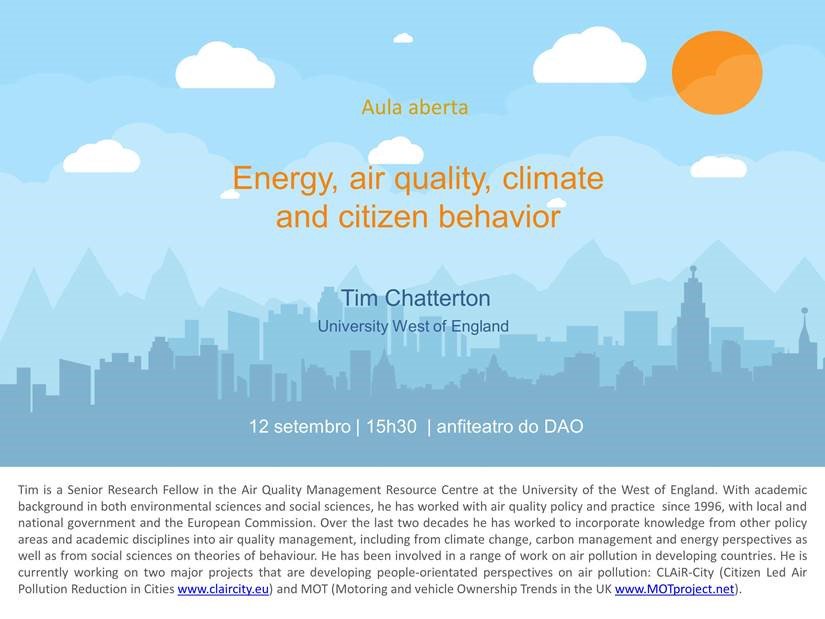
Tim giving lecture at Aveiro University

Whilst in Portugal, Tim visited colleagues at Aveiro University to discuss the ClairCity project (www.ClairCity.eu) and whilst there gave a lecture to staff and students on “Energy, Air Quality, Climate and Citizen Behaviour”

https://pbs.twimg.com/media/CsJBaPmXEAAuHuK.jpg:large

IEA Task XXIV Workshop and Behave Conference


Tim has been at the university in Coimbra, Portugal on energy behaviour business.

On Wednesday 7th September, he was an invited participant at the International Energy Agency Demand Side Management Task XXIV (Behaviour Change) workshop http://www.ieadsm.org/task/task-24-phase-2/


On Thursday and Friday he attended ‘Behave 2016’, the 4th European Conference on Behaviour and Energy Efficiency (http://www.uc.pt/en/org/inescc/org_scientific_events/behave2016) where he gave a presentation on work from the MOT project (www.MOTproject.net) on “Linking Household Energy Consumption from Domestic Gas and Electricity with Energy Consumed by Private Motor Vehicles”


Tuesday, 13 September 2016

Jo acknowledged for contribution to EC report on noise, air pollution and socioeconomic status

A new European Commission (DG Environment) Science for Environment Policy was published last Friday 9th September. The In-depth Report on 'Links between noise and air pollution and socioeconomic status', was produced by the Science Communication Unit at UWE with advice provided by AQMRC's Dr Jo Barnes.

Full citation for the report:
Science for Environment Policy (2016) Links between noise and air pollution and socioeconomic status. In-depth Report 13 produced for the European Commission, DG Environment by the Science Communication Unit, UWE, Bristol. Available at: http://ec.europa.eu/science-environment-policy (direct link here). 

Wednesday, 31 August 2016

Tim's research hits the headlines

Research by Tim (AQMRC) and Graham Parkhurst (CTS) into a lack of improvement in air pollution over past 20 years has hit the local and national headlines this week. Tim and Graham have been in London to present their work to the Royal Geographical Society but additional media interest in their work has stimulated discussion of the topic on news channels, print and digital media. UWE’s Press Release can be found here: http://info.uwe.ac.uk/news/uwenews/news.aspx?id=3442 and links to a small selection of articles on Tim and Graham’s work are shown below.


TIm gives presentation on air quality at DfT

On Tuesday 30th August, Tim gave a joint presentation with Professor Graham Parkhurst at the Department for Transport.  The presentation on 'Why after two decades is air pollution from transport not declining?'  Was part of the Royal Geographical Society knowledge exchange event organised by the Transport Geography Research Group.

TIm and Graham will also give the presentation at the annual RGS-IGB conference on Wednesday.
 
The work, which represents a summary of a considerable amount of research and practice by the AQMRC and Centre for Transport and Society over the last twenty years. 


TIm giving three presentations at annual RGS conference

IN addition to the joint presentation with Graham Parkhurst of the Centre for Transport and Society at UWE (described in another article) Tim will be also giving two other presentations at the 2016 Royal Geographical Society conference based on work from the MOT (Motoring and vehicle Ownership and Trends in. The U.K.) project www.MOTproject.net

The first of these will cover an extension to the work published the journal of Energy Research and Social Science earlier this year and will consider 'Energy and the Urban:Rural Divide'.  

The second presentation will consider 'The risk of spatial stress to electricity networks from deployment of electric vehicles'.


Monday, 18 July 2016

Everyday Futures Workshop

On 14th/15th July, Tim participated in a workshop at Lancaster University on ‘Everyday Futures’ http://wp.lancs.ac.uk/everydayfutures/

The workshop established a pan-European network of 21 researchers from a wide range disciplines who are all looking at aspects of how day-to-day life may change as time progresses.


The theme of the network ties in very closely with Tim’s work at UWE on the Horizon 2020 CLAir-City project (www.claircity.eu).


A series of essays on Everyday Futures arising from the workshop will be published online in September.


Wednesday, 6 July 2016

60 Years since the Clean Air Act

Yesterday marked 60 Years since the introduction of the Clean Air Act, a move which helped reduce the burden of visible air pollution on the health and wellbeing of the UKs citizens. Jim Longhurst the AQMRCs Executive Director noted that “The United Kingdom parliament passed the first Clean Air Act in 1956 in response to the public health catastrophe of the 1952 London Smog.  The UK became leaders in clearing the air, but can we say that now with a worsening air pollution problem, a growing public health burden  and, at best,  an inadequate governmental response? Furthermore, as a result of the recent referendum on membership of the European Union there is also concern that air pollution regulation will be diluted within the UK, putting the population at an increased risk of ill-health. The AQMRC will be following events closely over the months and years ahead and will continue to work towards cleaner air for all.
 

Wednesday, 29 June 2016

MOT project goes to Nottingham for Transport Practitioners' Meeting

Tim is involved in two presentations and a workshop for the MOT project (www.MOTproject.net) at the PTRC annual Transport Practitioners Meeting in Nottingham on Thursday 30th June.

The presentations will cover both a basic overview of the data, and how it can be used to link transport with both air pollution and energy agendas.  The workshop explore how the data and project findings can be made most accessible to end users.

https://www.ptrc-training.co.uk/Events/TPM2016.aspx

Monday, 27 June 2016

AQMRC participate in Air Pollution 2016 in Crete


Over the 20th to the 22nd of June Jim, Tim and Ben participated in the 24th International Conference on Modelling, Monitoring and Management of Air Pollution in Crete. Jim co-chaired the conference with Carlos Brebbia of the Wessex Institute of Technology, gave a keynote speech on the ‘Progress with air quality management in the 60 years since the UK Clean Air Act, 1956’, and chaired two sessions, the first of which was on the health effects of air pollution and the second on the monitoring and measurement of air pollution. Tim gave two talks at the conference, the first was on ‘An environmental justice analysis of exposure to traffic-related pollutants in England and Wales’ and the second on ‘A social and spatial analysis of emissions from private vehicle use in Great Britain’. Ben presented a paper on ‘A critical review of the robustness of the UK government's air quality plan and expected compliance dates’ and chaired a session on air pollution modelling.

All papers presented at the conference will be available through open access arrangements here: http://www.witpress.com/elibrary 
Several new acquaintances were made and the team looks forward to participating next year when the conference will be held in Cadiz, Spain. Details for this conference can be found here: http://www.wessex.ac.uk/conferences/2017/air-pollution-2017 

Thursday, 16 June 2016

New AQMRC paper on energy justice

Jo and Tim have just had a paper on mapping household energy consumption published in Energy Research and Social Science.  The paper is another output from the MOT (Motoring and vehicle Ownership Trends in the UK) project www.MOTproject.net.


The paper takes new datasets from the Department for Transport and Department of Energy and Climate Change and uses it to map and analyse patterns of energy use from domestic gas and electricity and from private vehicle use.

Then, based on identified inequalities in energy consumption and spatial structural determinants, it poses the question “Can we identify the difference between ‘energy decadence’ and ‘high energy need’?”


Highlights

• Analysis of new UK datasets based on over 70 million domestic energy meters and vehicle odometers.

• New spatial analyses of household direct energy consumption, through gas, electricity and private car use.

• Investigation of high energy consuming areas in terms of ‘choice’ or ‘need’.

• Assessment of greater capabilities of high energy consumers to reduce energy consumption.

• Recommendations for policy to target high energy consumers on the basis of principles of equity and justice.


The paper is open access.


Chatterton, T., Anable, J., Barnes, J. and Yeboah, G. (2016) Mapping household direct energy consumption in the United Kingdom to provide a new perspective on energy justice. Energy Research & Social Science. ISSN 22146296 http://dx.doi.org/10.1016/j.erss.2016.04.013


Abstract:


Targets for reductions in carbon emissions and energy use are often framed solely in terms of percentage reductions. However, the amount of energy used by households varies greatly, with some using considerably more than others and, therefore, potentially being able to make a bigger contribution towards overall reductions. Using two recently released UK datasets based on combined readings from over 70 million domestic energy meters and vehicle odometers, we present exploratory analyses of patterns of direct household energy usage. Whilst much energy justice work has previously focussed on energy vulnerability, mainly in low consumers, our findings suggest that a minority of areas appear to be placing much greater strain on energy networks and environmental systems than they need. Households in these areas are not only the most likely to be able to afford energy efficiency measures to reduce their impacts, but are also found to have other capabilities that would allow them to take action to reduce consumption (such as higher levels of income, education and particular configurations of housing type and tenure). We argue that these areas should therefore be a higher priority in the targeting of policy interventions.


Monday, 6 June 2016

UWE Bristol successful in £5.2 million (€6.7m) EU project tackling air pollution

Thousands of people across Europe will be invited to share their views on how to reduce air pollution and improve public health in six cities as part of a multi-million pound project featuring the University of the West of England (UWE Bristol).

In an innovative approach to addressing air quality, residents will use a specially-created game on their smartphones, tablets and laptops to suggest how their home cities should develop in future.

Responses gathered from players will form a 'people's vision' spelling out to civic leaders exactly how the cities should be shaped over the next 35 years – and what measures need to be taken to improve air quality, reduce CO2e emissions and diminish negative health effects.

Named CLAiR-City, the four-year project which kicked-off in Bristol last month, features 16 partners including the pilot cities of Bristol; Amsterdam; Aveiro, in Portugal; Ljubljana, in SIovenia; Sosnowiec, in Poland; and the Liguria region in Italy.

UWE Bristol's Dr Enda Hayes, Technical Director of CLAiR-City, said a bold approach was being taken because all other efforts were struggling to combat air pollution, a problem responsible for the deaths of more than 400,000 people in Europe every year.

Up to a third of Europeans living in cities are exposed to pollutant levels exceeding EU air quality standards, with approximately 90 per cent affected according to the World Health Organization's more stringent guidelines.

Dr Hayes, an Associate Professor and Director of the Air Quality Management Resource Centre (AQMRC) at UWE Bristol, said: "Air quality management is failing in many cities around the world. This is an exciting and innovative project to try to address one of the key issues – how do you empower citizens to define their own solution?

"Using game technology as an engagement platform means everyone's voice and opinion is valued. If you run traditional workshops or surveys it can be that the quiet voices get lost and the reach can be limited. With our game, everyone's voice is equal and we can all be experts on our own city."

Funded by the European Commission Horizon 2020 programme, the project is aimed at creating a major shift in public understanding towards the causes of poor air quality – encouraging a focus on people's everyday practices like commuting and shopping rather than technology such as cars, buses and HGVs.

Dr Hayes said: "To date, air quality policy has primarily been focussed on technology and technological solutions. Instead of apportioning the pollution to the technology (e.g. cars), this project will apportion it to people and our behaviour (e.g. why do we use our cars).

"By apportioning pollution to behaviour and practises, we want to give people a better understanding of how their behaviour generates pollution. If they change their behaviour it can have a substantial impact on a city. The innovation lies in how we are bringing social science into our data analysis and then engaging city citizens with that data to help them visualise and define their city's future."

The game, being developed by UWE's in-house gaming studio PlayWest, will give the player the chance to outline how they would like to live, behave and interact in their city up to 2050. Responses from players will lead to the creation of a 'citizen-led future city scenario' which will be delivered to city leaders as a 'policy package' document setting out what changes they would eventually like to see introduced.

Dr Hayes said: "We wanted to empower citizens to define their futures and use that to influence policy. We are using game technology to engage a wider population and to envision what a city looks like in 2050 so the project is particularly relevant to younger people.

"Also involved in the project is UWE Bristol's Science Communication Unit, whose internationally-recognised expertise in public engagement and dissemination will help enhance the reach of the study."

The project will also involve detailed data and policy analysis, with a study of existing evidence on themes such as energy and transport at a local, national and European level. It will explore six cities in detail but will also generate data which could be utilised by all EU cities with a population of more than 50,000.

The 16 partners include universities, cities, small and medium sized enterprises and research organisations.

Ten members of staff from UWE Bristol – which has received over £980,000 (€1.25m) of the total funding - will be involved including members of the Air Quality Resource Management Resource Centre, Science Communication Unit and PlayWest.

Jeroen van der Laan, of economic policy consultancy Trinomics, the project coordinator, said: "We are very excited to start implementing our CLAiR-City project over the next four years with the excellent group of Europe's leading research organisations and frontrunner cities we have in our consortium. CLAiR-City will develop innovative approaches and means of communication to inform European citizens about the air quality in their cities and engage them in forming ideas and pathways on how their living environment should look like in 2050."

UWE's Assistant Vice Chancellor for Environment & Sustainability, Professor Jim Longhurst, said: "CLAiR-City is a great example of how different expertise can be blended together across the university, and indeed Europe, to build imaginative and effective responses to the profound environmental and public health challenges we face."

Citizen Led Air pollution Reduction in Cities (CLAiR-City) Consortium Members:

1. Trinomics B.V. (Project Coordinator - Netherlands)

2. University of the West of England, Bristol (Technical Lead - UK)

3. Statistics Netherlands (Netherlands)

4. Technical University of Denmark (Denmark)

5. Norwegian Institute for Air Research (Norway)

6. PBL Netherlands Environmental Assessment Agency (Netherlands)

7. REC Regional Environmental Centre for Central and Eastern Europe (Hungary)

8. Techne Consulting (Italy)

9. Transport & Mobility Leuven (Belgium)

10. University of Aveiro (Portugal)

11. Municipality of Amsterdam (Netherlands)

12. Bristol City Council (UK)

13. Intermunicipal Community of Aveiro Region (Portugal)

14. Liguria Region (Italy)

15. Municipality of Ljubljana (Slovenia)

16. Sosnowiec City Council (Poland)


Thursday, 26 May 2016

Dr Ben Williams awarded Researcher of the Year - full-house for AQMRC

 
Dr Ben Williams has just been awarded the Department of Geography and Environmental Management Researcher of the Year, following in the footsteps of his AQMRC colleagues, Dr Enda Hayes, Dr Jo Barnes and D Tim Chatterton, who have in turn each received the accolade over the last three years.

Ben joined the Air Quality Management Resource Centre as a Research Associate in October 2014 and seamlessly embedded himself into the team while quickly exploring and building connections across the Department and Faculty. Ben has proven himself to be an able, diligent, enthusiastic and reliable team member and has been instrumental in helping the group grow and work towards the UWE Strategy 2020 priorities. Ben has taken a lead role in winning and delivering two major Research Council funded projects (‘EndotoxII’ funded by NERC and ‘Upstream’ funded by the Wellcome Trust) collectively valued at over £1.8m. Additionally, Ben has led a project to support Gatwick Airport in understanding the implications of the UK’s Air Quality Plans and is now frequently invited by Gatwick to be their representative at national events. Ben has taken a keen interest in knowledge exchange and public engagement activities such as running a well-attended air quality event during the 2015 Bristol Bright Night initiative and is now co-organising the ‘Routes to Clean Air 2’ conference with the Institute of Air Quality Management. He is building his publications profile while also developing his national and international standing through attendance and presentations at conferences. In addition to his research activities, Ben has proactively sought out UG and MSc projects to supervise, while also delivering teaching and CPD provision linked to his and AQMRC’s research.

Congratulations Ben, on this well-deserved award!


Tuesday, 3 May 2016

Tim giving talk at Centre on Innovation and Energy Demand

On Tuesday 3rd May, Tim will be giving a presentation to the Centre on Innovation and Energy Demand at Sussex University.

The talk, titled 'Energy Consumption from Private Motor Vehicles - Exploring a rich new dataset' will present an overview of the EPSRC funded Motoring and vehicle Ownership and Trends (MOT) project.

http://cied.ac.uk/engagement/newsandevents/events?id=35193

Friday, 22 April 2016

Emissions in the news - when will the government wake up?


In a week when we have seen evidence of further emissions cheating in Japan
(http://www.bbc.co.uk/news/business-36089558) while VW agrees compensation deals for its use of defeat devices in the US 
(http://www.bbc.co.uk/news/business-36103903), and DfT finally provides evidence that real-world emissions across all motor manufacturers are on average six times higher that the type approval tests (https://www.gov.uk/government/publications/vehicle-emissions-testing-programme-conclusions), how then can the PM continue to defend the motor industry (http://www.airqualitynews.com/2016/04/21/prime-minister-defends-car-industry-over-diesel-emissions/) that has proven itself time and again to not have public health interests at heart. When will the government wake up to the incontrovertible proof that our motor industry is killing us and that no amount of economic growth can justify that!